







What are the financial and organisational benefits of investing in acoustics?
What does investing in acoustics actually deliver? Many organisations experience the daily effects of reverberation, poor speech intelligibility and distraction from noise. This affects productivity, working comfort and collaboration. Yet acoustics still receives less attention in many projects than lighting, climate control or interior design. A shame, because good acoustics often delivers more than organisations expect.
Birgit Brinks
3 September 2026


What does poor acoustics cost an organisation?
Many organisations first look at the cost of acoustic solutions. Often, a more important question is: what does poor acoustics actually cost?
In spaces with lots of reverberation and background noise, employees lose concentration more quickly. After each interruption, it takes time to regain full focus and get back to work. In addition, our brains continuously process all the sounds in our surroundings. This requires energy, even when people are not consciously aware of noise pollution.
Poor acoustics regularly lead to:
- More distractions during work
- Lower concentration
- Longer meetings
- Higher mental load
- Unnecessary stress
- Less effective communication
- Lower employee satisfaction
Research by the Leesman Index shows that noise nuisance is among the most frequently cited disruptive factors in the office. Leesman data indicates that ‘noise levels’ are important to 70% of employees, while only 35% are satisfied with them. Even in offices that excel in most areas, this remains a problem: at Leesman+ workplaces, certified high-performing offices, satisfaction with noise levels is only 45%. The Arboportaal of the Ministry of Social Affairs and Employment also confirms this picture: the report ‘Tired of noise’ shows that around half of workers are annoyed by noise in the workplace. For 34% of them, this leads to specific complaints, such as headaches, reduced concentration or misunderstandings.
Research into concentration and interruptions shows that employees often need a great deal of time to regain full focus after a disruption. This is also confirmed by the Leesman research: of the employees who are dissatisfied with noise levels, 46% say that their workplace does not enable them to work productively. Wellbeing also suffers: this group is 45% less likely to experience a positive impact of the workplace on their overall wellbeing
These hidden costs do not appear directly on an invoice, but affect an organisation’s performance every day.
How does good acoustics increase productivity?
In modern working environments, much of the work revolves around concentration, knowledge sharing and collaboration. That is precisely why acoustics are playing an increasingly important role.
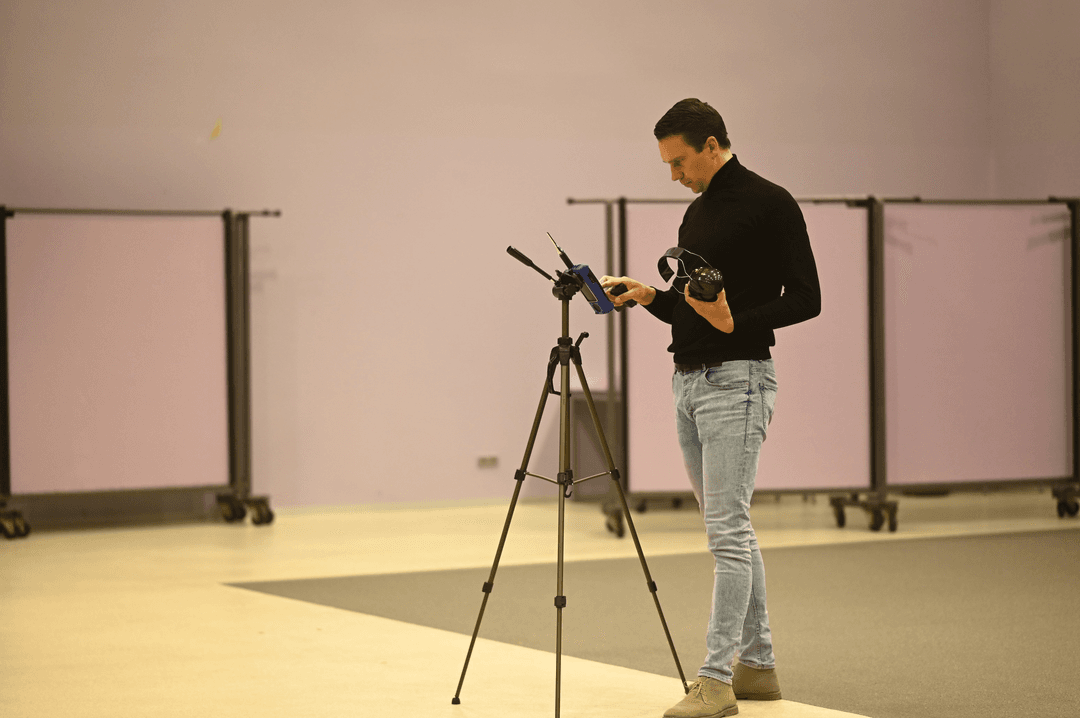
At EASY Noise Control, we regularly see during acoustic measurements that the reverberation time in offices is considerably higher than desirable for concentrated work. Modern office environments with lots of glass, concrete and other hard surfaces in particular often produce more sound reflection than organisations expect.
In many cases, employees experience the effects every day, while the acoustics have never been measured objectively. That is precisely why an acoustic analysis is often the first step towards a more productive and comfortable working environment. When sound remains in a room for less time, a greater sense of calm is created. Employees maintain their focus for longer and carry out tasks more efficiently.
Good acoustics provide, among other things, the following:
- Greater concentration at work
- Fewer distractions
- Work more efficiently
- Higher quality of work
- More peace and quiet in open-plan offices
The financial impact of better acoustics is often underestimated. Even within small teams, a modest improvement in concentration and efficiency can deliver a significant financial benefit over the course of a year. That is why more and more organisations are looking not only at the purchase costs of acoustic solutions, but also at the savings generated by higher productivity, better collaboration and more efficient use of spaces.
What benefits does better acoustics provide for employees?
The impact of sound extends beyond productivity alone. Our brains remain continuously alert to stimuli from the surroundings. In spaces with a lot of reverberation and background noise, this requires extra effort. As a result, employees become tired more quickly. Good acoustic design creates a more pleasant working environment. Conversations sound clearer, distracting reflections are reduced and the space feels calmer.
Employee benefits:
- Less stress
- Less mental fatigue
- Better working conditions
- More energy throughout the working day
- A more pleasant working environment
Feedback from our customers shows that employees say pleasant acoustics have a positive impact on their job satisfaction. For organisations that invest in employee wellbeing, acoustics are therefore an important part of a healthy workplace.
How does good acoustics improve communication?
Good communication forms the foundation of every organisation. Yet the acoustics in meeting rooms, discussion areas and meeting spaces often receive insufficient attention. At EASY Noise Control, we regularly see meeting rooms with a lot of glass. Although these spaces look modern and open, the hard surfaces often cause problems with speech intelligibility.
When participants have more difficulty understanding each other:
- Do they ask for repetition more often
- Do misunderstandings arise more quickly
- Do meetings take longer
- Is valuable information lost
Good acoustics improve speech intelligibility and make discussions more effective.
The result:
- Shorter meetings
- Better collaboration
- Fewer misunderstandings
- Greater engagement
- More efficient decision-making
For organisations that hold many meetings every day, this delivers consistent time savings.
Case study: getting more value from a meeting room
During an acoustic survey at MTEX Holland, we mapped the acoustic performance of a meeting room with many hard finishes. The measurements showed that sound remained in the room for too long, which had a negative impact on speech intelligibility and comfort during meetings.
By combining sound-absorbing ceiling and wall solutions, we improved the acoustic balance. The result was a calmer soundscape, more intelligible conversations and a meeting room that better supports the users’ daily activities.
What are the benefits of good acoustics for customers and visitors?
The experience of customers, visitors and applicants begins as soon as they enter. A space with a lot of reverberation often feels busy and unsettled. A space with well-balanced acoustics, on the other hand, conveys comfort, quality and professionalism.
This plays an important role in, among other things:
- Offices
- Showrooms
- Hospitality venues
- Healthcare facilities
- Educational buildings
- Municipal buildings
A pleasant acoustic environment enhances an organisation’s overall experience and contributes to a positive first impression.
Get more from existing spaces
When organisations face spatial problems, they often immediately think of renovation. In practice, acoustics are frequently a major cause. A meeting room that is not pleasant to work in, a restaurant where guests struggle to hear each other or a classroom with a lot of reverberation are not being used to their full potential. With targeted acoustic solutions, the quality of a space can often be improved considerably without extensive structural modifications.
Because of this:
- Spaces function better
- Improves the user experience
- Increases satisfaction
- Reduces the need for renovations
- Increases the return on existing square metres
At a time when square metres are becoming increasingly valuable, organisations are looking for ways to make better use of existing spaces. Improving acoustics can be a relatively simple solution compared with refurbishing or extending the building.
What is the payback period for an investment in acoustics?
The exact payback period varies by organisation and situation.
Factors such as:
- The number of users
- The function of the space
- The current acoustic situation
- The type of solution
play an important role in this.
Nevertheless, many organisations soon experience the benefits of better acoustics. Employees work more comfortably, communicate more effectively and make better use of spaces.
A high-quality acoustic solution will essentially last a lifetime. The material retains its acoustic properties with normal use and proper maintenance. This means the investment continues to add value for many years. In addition, most acoustic solutions can be installed intelligently, making them easy to relocate should an organisation move premises or renovate.
Although the exact payback period varies from situation to situation, organisations often experience the benefits immediately in practice. Employees report fewer distractions, conversations are clearer and spaces are used more effectively. As a result, the return consists not only of financial benefits, but also of higher employee satisfaction, a better user experience and a more pleasant working environment.
Why More and More Organisations Are Investing in Acoustics
Where acoustics used to be regarded primarily as a technical subject, it is increasingly appearing on the agendas of HR managers, facilities managers, architects and senior management.
That makes sense. Good acoustics directly contribute to:
- Productivity
- Workplace happiness
- Health
- Customer experience
- Property value and attractiveness of the working environment
- Effective use of space
As a result, acoustics are not merely an investment in a space, but above all an investment in the people who use it every day.
Conclusion
The question is not only how much acoustic solutions cost, but above all what poor acoustics cost an organisation every day. Investing in acoustics contributes to greater concentration, better communication, less stress and a more pleasant working environment. In addition, organisations use their spaces more effectively and improve the experience of employees, customers and visitors.
Organisations invest heavily in people, technology and premises. Without good acoustics, you do not make the most of these investments. That is precisely why acoustics are not a cost, but an investment in performance, wellbeing and the quality of the working environment.
At EASY Noise Control, that is why we look beyond noise reduction alone. With the help of acoustic measurements, practical advice and effective solutions, we help organisations get more out of their working environment. After all, a space with pleasant acoustics supports not only the wellbeing of its users, but also the organisation’s performance.
FAQs
How do you recognise reverberation, hollow sounds, and echoes in a space?
Reverberation, hollow sounds and echoes are recognisable by a sound that lingers after you've spoken. In a space with reverb, your voice sounds less sharp and the sound appears to "float" for a moment. With hollow sounds, you hear a dull, empty noise, especially when you walk, talk, or clap. An echo occurs when the same sound clearly bounces back from a hard wall or ceiling.
Spaces with many hard materials, such as concrete, glass or tiles, will exhibit these effects more quickly. You also often notice that conversations are harder to follow and that you become fatigued more quickly.
What is reverberation?
Reverberation occurs when sound waves reflect off hard surfaces and repeatedly re-enter the space. This is also known as echo. You hear the sound lingering longer, which increases noise in the room and makes voices less clear. By reducing reverberation, the sound becomes quieter and voices are easier to understand.
What is acoustics?
Acoustics are different for everyone. This is because everyone experiences sound differently. The characteristics of the sound in a space determine how you perceive that sound. Someone who is used to spaces with a lot of reverberation often finds a similar space pleasant and may describe the acoustics as good. Someone who is accustomed to spaces with little reverberation might find that same space uncomfortable and may describe the acoustics as poor. You might experience the acoustics as good, while someone else might find it less pleasant. In short: acoustics are your personal perception of sound in spaces and environments, and that perception varies from person to person.
What does an acoustic measurement provide?
An acoustic assessment provides clear insight into how sound behaves within your open-plan office, classroom, sports hall or, for example, GP surgery. The assessment shows where reverberation occurs, how sound travels through the space and which factors cause disturbance or reduced speech intelligibility. Based on this objective analysis, we identify the key problem areas and determine which measures will have the greatest impact.
With these insights, you can make targeted choices about, for example, acoustic wall panels, ceiling panels, baffles or partition walls. This helps you avoid unnecessary investment and focus on solutions that genuinely deliver results. An acoustic assessment therefore forms the basis for greater peace and quiet, improved concentration, higher productivity and a pleasant working environment for all employees.
In which buildings does EASY Noise Control carry out acoustic measurements?
We measure acoustics in commercial buildings, such as:
offices
hospitality venues
educational facilities
healthcare institutions
industrial spaces