








The cocktail party effect sounds gezellig, but what is it actually?
The cocktail party effect may sound positive, but in practice it often causes discomfort. This effect is often mentioned in conjunction with the Lombard effect. They are two different effects that are closely related and mutually reinforce each other. Together, they make conversations in busy environments increasingly difficult to understand.
Birgit Brinks
28 July 2026
The Lombard Effect: speaking louder without noticing it
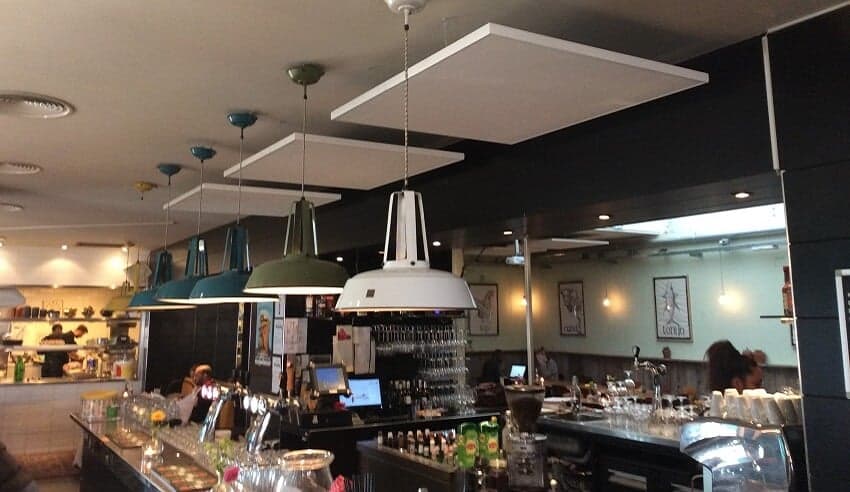
The Lombard effect is the automatic tendency to speak louder in a noisy environment. You do this unconsciously because you wish to remain understandable. This often happens in restaurants and event venues where multiple groups of people gather simultaneously. These spaces are often modern and atmospherically decorated. Additionally, they make relatively extensive use of hard materials such as concrete, glass, and wood in walls, ceilings, and interior fittings. Sound-absorbing materials are often absent. As a result, sound waves continually bounce back and forth within the space. The consequence is that sound persists longer. You experience this as echo and constant background noise. Because there's more and more noise, you start speaking louder. Others do the same, and thus a vicious circle of increasing noise, which we perceive as loudness, is created. This is precisely the Lombard effect.
The cocktail party effect that makes conversations harder to follow
The cocktail party effect relates to how well you can perceive sound and speech in a busy environment. It describes your ability to follow a single conversation while many other sounds are around you. People vary greatly in this ability; some can do it naturally better than others. Especially people with hearing difficulties and those over 60 years old, of whom 60% experience hearing loss, find this particularly challenging. When there is more background noise, it becomes harder to understand conversations. You miss words and need to put in more effort to follow the conversation. Whether you raise your voice or not, this situation is tiring and causes you, whether you like it or not, to withdraw and lose track of the conversation.


How do these effects reinforce each other?
When conversations become more difficult to understand, you and the people around you tend to speak louder. This is known as the Lombard effect. The noise level increases further, which also amplifies the cocktail party effect. As the ambient noise rises, it becomes increasingly difficult to perceive a single specific sound source. The result is a noisy and exhausting environment. Most guests find this unpleasant, and some leave earlier than planned. This has a negative impact on the guest experience and ultimately on the turnover of the hospitality business.
Why Good Acoustics Are So Important
In recent years, there has been increasing attention to acoustics in dining establishments. Aiming for: better speech intelligibility and less noise. Good acoustics make conversations quieter and more pleasant. And that directly contributes to what hospitality is all about: a enjoyable guest experience, where people stay longer and are happy to return.