







How sound works: why you can’t hear everything in the workplace
Do you recognise this? You hear a high-pitched ringing, but your colleague hears nothing. Or someone walks past behind you and you don’t hear them coming. Your brain filters sound continuously. It blocks unimportant background noises, such as the hum of a fridge. It doesn’t register sounds that are present all the time and pose no danger. And it effortlessly picks out a single voice in a busy, noisy room, while the rest of the din fades into the background. So our brains don’t register every sound. But why not? In this blog, we explain what sound is and how your brain processes it. In short: your brain processes sounds between 25 and 16,000 Hz, and actively filters out the rest. That’s why noise is measured in dB(A) in the workplace, as this unit most closely reflects your own perception of sound.
Birgit Brinks
27 August 2026
How is sound produced?
Sound is a vibration that travels through a medium such as air or water. We call this a sound wave. Anything that moves or collides with something causes such a vibration. For example, clap your hands. Your hands come together and compress the air. This creates a vibration that travels through the air and reaches your ear.
Your eardrum picks up these sound waves and starts vibrating due to the change in air pressure. The hair cells in your cochlea then convert these vibrations into electrical signals. These signals are sent to your brain and converted into sound. And you experience that as sound.
Your ear picks up every vibration. Nevertheless, there is a lower and upper limit to what you can hear:
- Below 25 Hertz (Hz), you usually can’t hear anything, but you can often feel the vibration. Think of heavy machinery or booming bass.
- Above 16,000 Hz, you can also barely hear anything. This applies, for example, to certain high-pitched whistles.
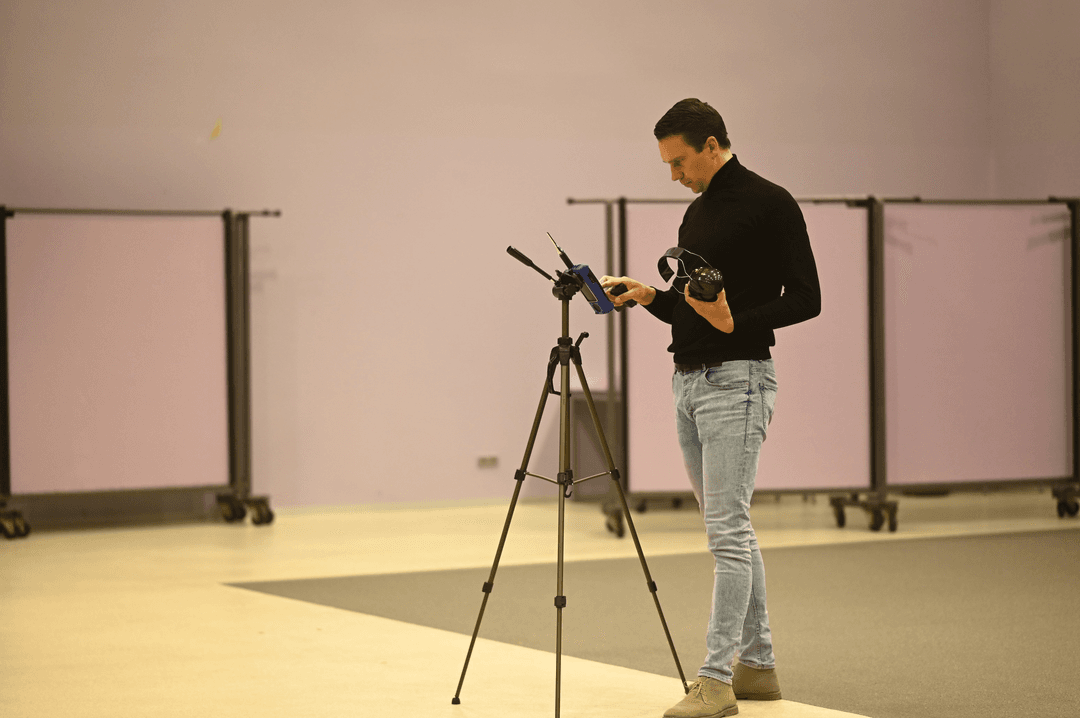
Your body therefore mainly converts sound waves between 25 and 16,000 Hz into signals sent to your brain. The actual difference in which pitches we pick up varies from person to person. At EASY Noise Control, we carried out a test during a training session in which a 60-year-old colleague could hear pitches up to 12,000 Hz, while a 23-year-old colleague could hear pitches up to 16,000 Hz. In the workplace, this means that dangerous or important situations may sometimes produce vibrations, but your hearing does not always relay them. This increases the risk of unsafe situations in a workshop, industrial hall or factory.
Measuring sound: what do decibel, dB(A) and frequency mean?
To understand why you cannot hear everything, we first look at how we perceive and measure sound. In practice, we mainly use three concepts:
- Decibel (dB):
Decibel is the measurement scale for sound level. The decibel scale is logarithmic: each increase of 10 dB feels 10 times as loud. A sound level of 60 dB therefore sounds 10 times as loud as 50 dB.
A clear example: one violinist produces a tone of approximately 440 Hz at a sound level of 95 dB. 100 violinists playing at the same time? You do not hear 95 dB multiplied by 100; instead, the dB level rises to 115 dB (= log(100) * 10). The sound level does not increase linearly with the number of violins. This is because sound works logarithmically.
- Decibels with A-weighting (dB(A))
dB(A) takes into account how your ear experiences sound. This measurement method automatically adjusts for how sound feels to you. This unit better reflects human perception. That’s why you use dB(A) as the standard in occupational health and safety.
- Frequency (Hertz)
Hertz is the unit of frequency. It indicates how many vibrations occur per second. At 100 Hz, the air vibrates 100 times per second.
The difference between Hertz and decibels in practice
dB refers to sound level, dB(A) refers to how loud you perceive something, and Hz refers to pitch. There is no direct relationship between these concepts, but there is an indirect relationship between dB(A) and Hz.
The frequency in Hz affects how you perceive the sound pressure in dB. Two machines may sometimes have the same sound level of 100 dB, but a different frequency in Hz. A generator and a circular saw both produce 100 dB, but the generator operates at 63 Hz and the circular saw at 4000 Hz. Because of this difference in Hz, you perceive the circular saw as louder than the generator.
Which sounds can you hear best?
Your brain picks up vibrations between 25 and 16,000 Hz best. Your brain also pays extra attention to sounds within the speech frequency range: between 110 Hz and 8000 Hz, it is particularly alert.
Voice frequencies in Hertz:
- Female voice: 200 Hz - 900 Hz
- Male voice: 110 Hz - 440 Hz
Frequencies in Hz:
- Vowels (letters: a, e, i, o, u): 250 Hz to 2000 Hz
- Voiced consonants (letters: b, d, v, z, g, m, n, ng, l, r, j, w): 250 Hz to 4000
- Voiceless consonants (letters: p, t, k, f, s, e): 2000 Hz to 8000 Hz.
Your hearing is therefore tuned to understanding speech. In a noisy working environment, it is more difficult to understand each other.
Why do you use dB(A) in occupational health and safety?
In occupational health and safety, we use dB(A) because it corresponds to how people experience sound. Your ear is less sensitive to low frequencies. The A-weighting associated with dB(A) corrects for the ear’s sensitivities, thereby giving a more realistic picture of what you hear and how taxing the sound is.
What do you do in the workplace?
Your hearing does not perceive everything. You only hear a certain range of frequencies and do not experience sound linearly. That is why we measure sound in dB(A), and why paying attention to noise is important for safety and health in the workplace. By following these steps, you will work more safely:
- Measure sound levels in dB(A): this gives you a realistic picture of the strain on your hearing.
- Wear hearing protection in good time: use earplugs or earmuffs from 80 dB(A) onwards. Arboportaal identifies this level as the point at which your employer is required to make hearing protection available. From 85 dB(A) onwards, you are also required to wear that protection.
- Pay attention to communication: make sure colleagues can hear each other clearly, especially in noisy environments.
- Limit your exposure: alternate tasks or spend less time working in noisy areas.
- Make signals visible: use visual signals, such as lights, when sound cannot be heard clearly.
Be mindful of noise. This protects your hearing and helps create a safer workplace. But how do you know whether the noise level where you work already poses a risk? Request a free on-site noise measurement. Our acoustic consultants measure the noise in your factory, industrial hall or workshop and immediately tell you how to improve the acoustics and comply with occupational health and safety legislation.
FAQ
At what dB(A) level should I take action in the workplace?
If noise levels reach 80 dB(A), your employer must provide hearing protection. From 85 dB(A), you must also wear that protection. Unsure about the noise level in your workplace? A professional noise assessment will provide clarity within one day and prevent you from discovering hearing damage only when it is too late.
Why do I sometimes struggle to understand colleagues, even though the sound isn’t extremely loud?
Speech is mainly between 110 and 8000 Hz. Machines with a frequency in that range therefore drown out voices, even at the same or an even lower overall sound level. A circular saw at 4000 Hz thus interferes with speech intelligibility more than a generator at 63 Hz, even if you measure the same number of decibels for both machines. If you work in a room with many hard surfaces, this effect is amplified: sound bounces back and overlaps with voices. Acoustic solutions such as absorptive panels specifically reduce these disruptive frequencies, without you having to modify the machine itself.
Is noise-induced hearing damage in the workplace reversible?
No, exposure to excessively loud noise permanently damages the hair cells in your cochlea. These cells do not repair themselves. The World Health Organization (WHO) identifies prolonged exposure above 85 dB(A) as a direct cause of permanent hearing loss. If you wear hearing protection in time, you can completely prevent this risk. Once the damage occurs, it therefore remains present for the rest of your life.